Leshan vs Dujiangyan — Which Day Trip Should You Do from Chengdu?
Both Leshan and Dujiangyan are popular day trips from Chengdu. Both are UNESCO World Heritage Sites. They're very different in character and logistics.
The short answer:
- Do Leshan if you want a visually powerful, single-focus experience and have a full day to spare.
- Do Dujiangyan if you have half a day, want to combine it with a second panda visit, or prefer something that requires less travel.
- Do both if you have 5+ days and want to leave the city twice.
The Core Difference
| Leshan | Dujiangyan | |
|---|---|---|
| What it is | A giant stone Buddha carved into a cliff | An ancient water management system still in use |
| Travel time from Chengdu | 1–1.5 hours each way | 50–70 minutes each way |
| Time needed at the site | 2.5–3.5 hours | 2–2.5 hours |
| Good to combine with | Nothing nearby (it's the main event) | Panda Breeding Center OR Qingcheng Mountain |
| Visual impact | Very high — the scale is dramatic | Moderate — interesting, but more conceptual |
| Best for | Anyone who wants a clear "wow" moment | Anyone who wants variety or is interested in history/engineering |
| Total day required | Yes — this is a full day | No — half day possible; often paired with something else |
Leshan in Depth
What You're Going to See
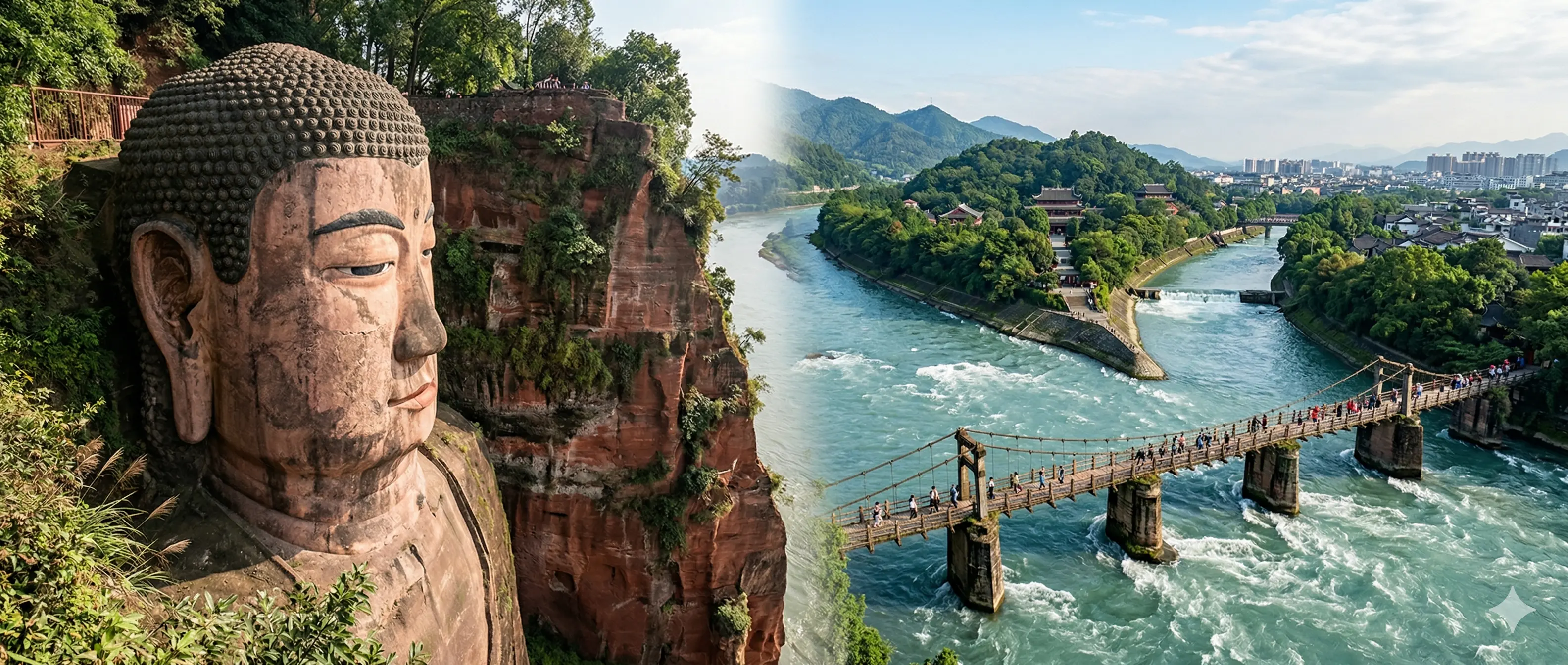
The Leshan Giant Buddha (乐山大佛) is 71 meters tall — the largest ancient stone Buddha in the world, carved between 713 and 803 AD. It sits at the confluence of three rivers, visible from boats and from the cliff path that descends to its feet.
The experience is primarily visual. The scale is the point. You stand at the Buddha's feet, and it's significantly bigger than you expected. Photos don't convey it.
The Travel Investment
Getting to Leshan takes effort: metro to Chengdu East Station, high-speed train (~60 min), then taxi or bus to the site. Total travel time one way: 1.5–2 hours. Round trip plus site time = a full day, minimum 7–8 hours out of your hotel.
Who Should Prioritize Leshan
- Anyone who wants the most visually memorable experience available from Chengdu
- Travelers who prefer single-focus days over cramming multiple things in
- Anyone with 4+ days in Chengdu who has a full day to dedicate to a trip
→ Full logistics: Leshan Giant Buddha Day Trip Guide
Dujiangyan in Depth
What You're Going to See
Dujiangyan (都江堰) is a 2,300-year-old irrigation and flood control system built in 256 BC by the Qin dynasty governor Li Bing. It diverts the Min River without a dam — a feat of hydraulic engineering that has kept the Chengdu Plain fertile and flood-resistant ever since.
It's a UNESCO World Heritage Site, but it rewards visitors who come with some context. If you just show up, you're looking at weirs, fish-mouth structures, and river channels — interesting if you understand what you're seeing, less so if you don't.
A simple explanation: The Min River descends from the mountains with enormous force. Li Bing built structures that split the river into inner and outer channels, controlling the water's speed and volume without a dam. The system has been maintained and expanded for 2,300 years and still works today.
Walking the site takes you over the structures, through an adjacent historic town (Lidui Park), and past temples built to honor Li Bing. The setting is scenic — mountains, rushing water, old temples.
The Travel Advantage
Dujiangyan is much easier to reach than Leshan. The intercity metro line (成灌快铁) runs directly from Xipu Station (Metro Line 2) to Dujiangyan Station. Total travel time: about 55–70 minutes. No train booking required — just tap in and go.
Combining Dujiangyan with the Panda Center
The China Conservation and Research Center for Giant Panda (Dujiangyan Base) is near Dujiangyan Station and the irrigation site. Many visitors combine both in one day:
- Morning: Dujiangyan irrigation system (2–2.5 hours)
- Afternoon: Dujiangyan Panda Base (2–3 hours)
This is the most efficient use of a Dujiangyan day. Note that this panda facility is different from the main Chengdu Panda Base — less crowded, more naturalistic, higher entry price (~¥150). If you've already visited the Chengdu base, this is a viable second visit; if you haven't, consider whether you'd rather do the main Chengdu base first.
Combining Dujiangyan with Qingcheng Mountain
Qingcheng Mountain (青城山) is 15km from Dujiangyan Station. It's a Taoist mountain with temple paths and good hiking. The front mountain (前山) is developed with a cable car; the back mountain (后山) is quieter and more natural.
Combining Dujiangyan irrigation + Qingcheng Mountain front makes a reasonable day, but only if you arrive early and move efficiently. Budget: Dujiangyan entry ~¥80, Qingcheng front mountain ~¥60.
Side-by-Side Decision Guide
Choose Leshan if:
- You have a full day with nothing else planned
- Visual scale and impact matter most to you
- This is your only day trip and you want the one that's hardest to forget
- You're okay with the longer travel time
Choose Dujiangyan if:
- You have half a day or want to combine with pandas/hiking
- You're interested in ancient engineering or history
- You want the easiest possible day trip logistics from Chengdu
- You've already seen Leshan before
Do Both if:
- You have 5+ days and want to leave the city twice
- Suggested order: Dujiangyan on Day 4 (easier day), Leshan on Day 5 (more intense day). Or swap — doesn't matter much.
What If I Can Only Do One?
Choose Leshan.
For a first-time visitor, Leshan has higher visual impact and is the experience more likely to stay with you. The longer travel time is worth it once.
The exception: if pandas are your primary reason for visiting and you've already been to the main Chengdu Panda Base, the Dujiangyan Panda Base + Dujiangyan combination gives you a different panda experience in a more manageable day.