Chengdu Language Tips for Non-Chinese Speakers
English in Chengdu is available at international chain hotels, major tourist sites, and some staff at Panda Base and train stations. Outside of those contexts, you're largely without English support.
This is not a reason to worry — it's a reason to prepare a few specific things. This guide covers what to prepare, what works, and where you'll hit actual friction.
The Honest Assessment
Where English works:
- International chain hotel front desks
- Chengdu Panda Base (signage in English, some staff)
- Tianfu Airport and major train station information windows
- Some higher-end restaurants with English menus
- Metro stations (bilingual signage throughout)
Where English doesn't work:
- Most restaurants (menus are Chinese only)
- Street food stalls
- Local buses
- Small shops and markets
- Taxi drivers (most don't speak English)
- Any situation off the tourist track
The gap matters most for ordering food, taking taxis, and anything unexpected (health issue, lost item, wrong turn). Here's how to handle each.
The Apps That Actually Help
Google Translate — Camera Mode
The most useful tool for non-Chinese speakers in Chengdu.
How to use: Open Google Translate, select Chinese (Simplified) → English, tap the camera icon, and point it at a menu, sign, or text. The app overlays a real-time translation on your screen.
It's not perfect — Sichuan dialect words and restaurant-specific terms sometimes produce odd translations — but it gets you 80–90% of the way to understanding what you're looking at.
Download the Chinese offline language pack before your trip. You need it when you don't have internet.
Pleco — For Anything More Specific
Pleco is a dedicated Chinese dictionary app. Better than Google Translate for looking up specific words, especially food ingredients or place names you're trying to understand. Free version is sufficient.
Amap (高德地图) — Maps That Work in China
Google Maps works in China but can be slow and occasionally shows outdated information. Amap (Gaode Maps) is China's most accurate mapping app and has an English-language mode (limited but functional for navigation).
Download before arriving. Use for walking directions and to confirm DiDi drop-off points.
WeChat — Translation Within Conversations
WeChat has a built-in translation function in its messaging: press and hold on any message to translate it. Useful when communicating with hotels, guesthouses, or local contacts over text.
Situations and What to Do in Each
At a Restaurant With No English Menu
Step 1: Use Google Translate camera on the menu.
Step 2: Point at what the table next to you is eating and say 这个 (zhège — "this one").
Step 3: Show this phrase on your phone: 推荐一个好吃的菜 (Tuījiàn yīgè hǎochī de cài) — "Please recommend a good dish."
For spice level:
- 不辣 (bù là) — not spicy
- 少辣 (shǎo là) — less spicy
- 微辣 (wēi là) — slightly spicy
- 中辣 (zhōng là) — medium spicy
Taking a Taxi
Don't rely on speech. Instead:
- Have your destination written in Chinese characters (copy from your hotel's website, or from a map app)
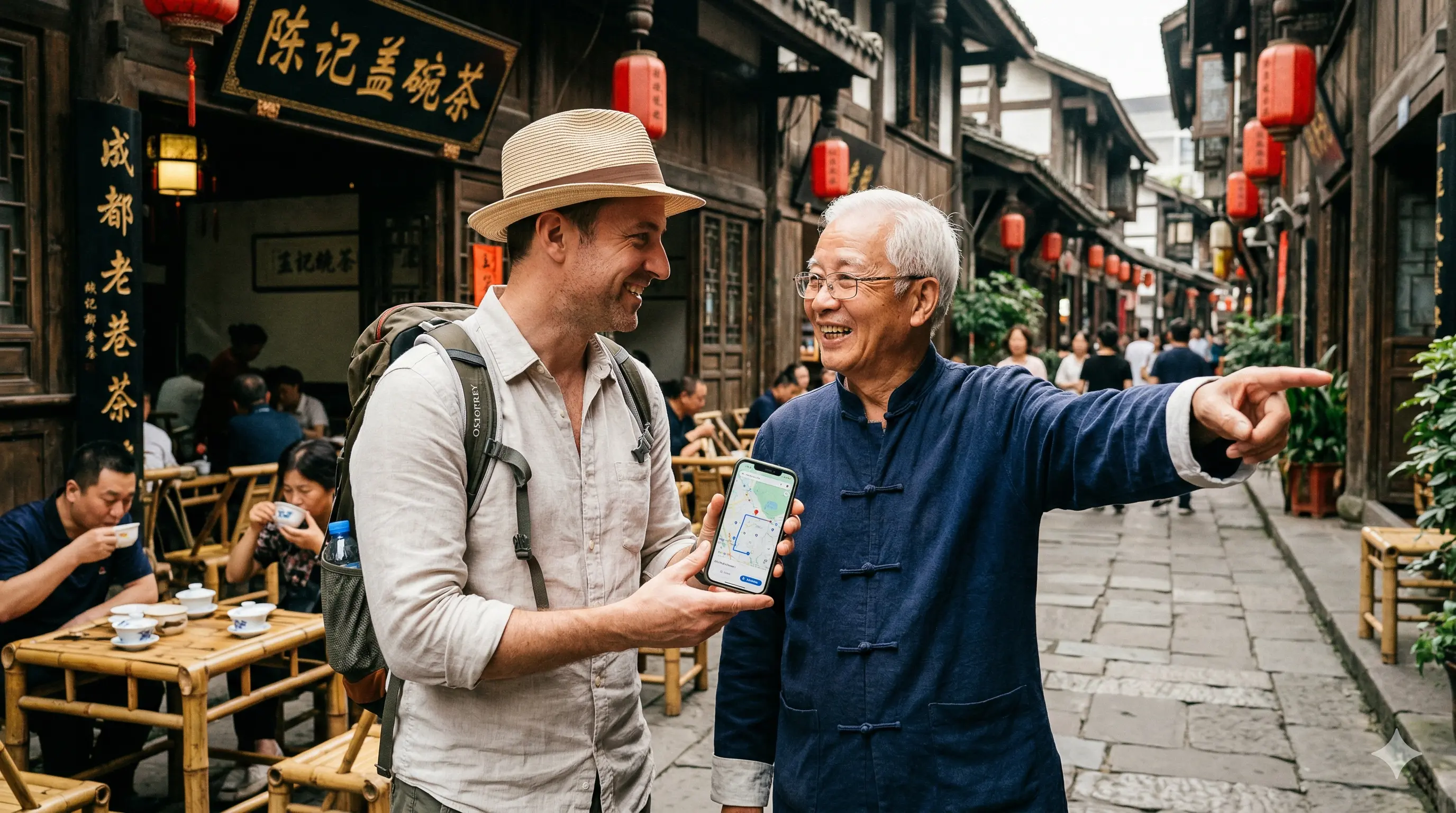
- Show the driver on your phone
- Use DiDi instead when possible — destination is typed, not spoken
Save these as screenshots before you need them in a taxi without internet:
| Destination | Chinese |
|---|---|
| Panda Base | 成都大熊猫繁育研究基地 |
| Kuanzhai Alley | 宽窄巷子 |
| Jinli Street | 锦里古街 |
| Chunxi Road | 春熙路 |
| Tianfu Square | 天府广场 |
| Chengdu East Station | 成都东站 |
| Shuangliu Airport | 成都双流国际机场 |
| Tianfu Airport | 成都天府国际机场 |
At a Hotel Check-In
International chain hotels have English-speaking staff. Mid-range and budget hotels: show your booking confirmation (most platforms show the booking in both languages). Staff understand the check-in process even without shared language.
One thing to know: All hotels in China must register your passport with local police. You hand over your passport briefly at check-in. This is standard and mandatory, not cause for concern.
Medical Emergency
If you need medical assistance:
- Emergency number: 120 (ambulance) — operators may not speak English; say your location clearly
- Your hotel front desk can call for you and translate — always faster than calling directly
- Major hospitals in Chengdu have international or VIP wards with English-capable staff:
- Travel insurance with a 24-hour assistance hotline (usually includes translation support) is worth having
A Short Practical Phrase List
You don't need to speak Mandarin. You need to recognize a few key phrases and show a few others. Here are the ones that come up most:
Essential:
| English | Chinese | Pinyin |
|---|---|---|
| How much? | 多少钱? | Duōshǎo qián? |
| Too expensive | 太贵了 | Tài guì le |
| Thank you | 谢谢 | Xièxie |
| OK / yes | 好的 | Hǎo de |
| I don't understand | 我不明白 | Wǒ bù míngbái |
| Where is the toilet? | 厕所在哪里? | Cèsuǒ zài nǎlǐ? |
| No spicy | 不辣 | Bù là |
| Less spicy | 少辣 | Shǎo là |
| I want this | 我要这个 | Wǒ yào zhège |
| The bill, please | 买单 | Mǎi dān |
Transport:
| English | Chinese | Pinyin |
|---|---|---|
| I want to go to... | 我想去... | Wǒ xiǎng qù... |
| Turn left | 左转 | Zuǒ zhuǎn |
| Turn right | 右转 | Yòu zhuǎn |
| Stop here | 就在这里停 | Jiù zài zhèlǐ tíng |
Food:
| English | Chinese | Pinyin |
|---|---|---|
| Is this spicy? | 辣不辣? | Là bù là? |
| No coriander | 不要香菜 | Bù yào xiāngcài |
| Vegetarian | 素食 | Sùshí |
| I'm allergic to... | 我对...过敏 | Wǒ duì...guòmǐn |
What Works Without Any Language Prep
Many situations in Chengdu resolve without language:
- Metro: Bilingual signs everywhere, touch-screen ticket machines with English option
- Tourist sites: Panda Base, Jinli, Kuanzhai Alley all have English signage
- Convenience stores (7-Eleven, FamilyMart): Point and pay
- Hotels: Booking confirmations are language-neutral
You don't need to speak Mandarin to have a good trip in Chengdu. You need a translation app, the addresses of where you're going in Chinese text, and a basic willingness to communicate through pointing and phone screens.